Showing posts with label Moscow. Show all posts

Thursday, 17 April 2014

VDNKh - Moscow's Economic Achievements Park to return to former glory

The All-Russian Exhibition Center (VVTs) in Moscow, famous for its Soviet-era pavilions representing the various republics of the Soviet Union, is undergoing a major facelift in a bid to become "beautiful and comfortable," according to the company that manages the property.

It has been rumoured that it is to revert to its Soviet-era name: Exhibition of Achievements of the National Economy (Russian: Выставка Достижений Народного Хозяйства Vystavka Dostizheniy Narodnovo Khozyaystva).


Here is a Lego model of the People's Fountain of Friendship which features in the grounds of the exhibition centre. I saw this Lego model in the Centre for life in Newcastle as part of a Lego exhibition comprising famous buildings / landmarks from around the world - I thought it was a bit strange that out of all of the most famous buildings in Moscow they chose to create a model of a relatively obscure fountain.

Wednesday, 5 February 2014

Winter Olympics, Sochi, Russia

Today, an American snowboarder pulls out of the Winter Olympics at Sochi, over safety concerns - and it's headline news; we have constant flow of negative reports filling our airwaves and newspapers: reports of unfinished venues, lack of accommodation for journalists, mild weather / potential lack of snow, terrorist attacks, environmental concerns, bribery and corruption, anti-gay legislation; huge costs and budget overruns. I can't help thinking that the western media is rubbing its hands with glee over any scandal or problem affecting the forthcoming Winter Olympics - they want it to fail. 

Even the supposed fact of a journalist bitten by the tiger that Putin was photographed with is seen as newsworthy (the tiger in question is just a cub, and there is some doubt over whether the incident happened. 

Sure, this is a massive propaganda exercise for President Putin, which may or may not be successful in masking or fixing any of Russia's many problems, but it is seen on the international stage as an opportunity for political point scoring.

One notable exception to this negativity was a recent 2-part BBC program: Russia on 4-wheels - a whistle stop tour of the "new" and "old" Russias. Two presenters set off from Sochi in different directions: one in a modern armour plated people carrier (more like a tank) favoured by oligarchs, heading northwards to Moscow, St Petersburg and Murmansk; the other in a 40 year old UAZ headed off eastwards to the Urals via Togliatti, Volgograd, Perm and Nizhny Novgorod. I enjoyed the program and I felt it gave a fairly even handed coverage of Russia in general and the Sochi Olympic preparations in particular - it was a fairly short series - two hour-long episodes to cover a lot of material.

Their report on Sochi visited the impressive facilities, the huge infrastructure projects - the presenters seemed genuinely impressed and were positive about the faciltiers.  But they didn't gloss over some of the negatives: the alleged corruption and the adverse environmental impact on Sochi and it's residents.

Much has been made of the huge cost of hosting the Olympics - as if this alone was evidence of corruption. The scale of spending is huge. The most expensive Olympics to date was Beijing which came in at $43 billion - the London games were a modest $10.4 billion. Sochi 2014 is estimated to be $50 billion. This seems at first glance to be profligate to the extreme, with the cost of hosting the games generally in the region of $3 billion.  But much of the costs incurred in Sochi relate to the infrastructure and civic development rather than on Olympic facilities alone - and this has been a mammoth undertaking.  

There are seven new venues built in two locations: an Olympic Park was constructed in Sochi's Imeretinsky Valley on the coast of the Black Sea, with Fisht Olympic Stadium and the Games' indoor venues located within walking distance, and snow events will be held in the nearby mountains at Krasnaya Polyana - at a new, world-class ski resort which has been built

But this represents a very small part of the overall project -  in addition, preparation for the games has included modernizing the telecommunications, electric power, and transportation infrastructures of the region. This has involved building new and improving many roads, tunnels, bridges, interchanges, railroads and stations in and around Sochi. There are new road and rail links (a four-lane highway up the mountains, and a high speed train link: Moscow to Adler, near Sochi), and extensive tunneling through the mountains.  
This has generally been overlooked by western media.

Legacy is an important consideration in Olympic developments, this one will be huge for the region.  With improved links to Moscow and regional connections, it may help to establish Sochi as a year round international tourist destination.  

I think it's time to stop the sniping, the criticisms, and negativity and lets just enjoy the games.

Thursday, 7 March 2013

My first trip to Russia

25 years ago today I first went to Russia - March 1988.


Me & Steve boarding the Ilyushin 76
The trip was advertised in the old Soviet Weekly newspaper, who arranged it through Progressive Tours, using the Soviet Trade Union tourist agency.

Of course, it was still the USSR at this time, and the reforms under Gorbachev's policies of Glasnost and Perestroika were slowly gathering pace. Although there was a greater degree of openness, more freedoms permitted, it remained a totalitarian socialist state; the sort of individual freedoms enjoyed by citizens of western democracies were still absent from Soviet society.


Me outside Central Tourist House
I went with my friend Steve, flying by Aeroflot from Heathrow to Moscow on an Ilyushin 76 aeroplane. In Moscow, we stayed in the Central Tourist House hotel - a Soviet trade union hotel - which isn't central at all.  The Tsentralny Dom Turista (as it is still called, I think) is  located on what was then the outskirts of south west Moscow, in the Tropareva district, about a 20 minute walk from Yugo Zapadnaya metro station. 
Tropareva district Moscow.  View from 22nd floor of Central Tourist House. Looking towards YugoZapadnaya metro

We stopped one night on Moscow. Next day we were ferried, by an Intourist coach, to one of the so-called "Golden Ring" cities surrounding Moscow: Vladimir. We stayed for a few nights here at the Klyasma hotel - just outside of Vladimir town centre.

While we were there, we visited the ancient churches of Vladimir and other historic buildings such as the Golden Gate.  We also visited the nearby ancient town of Suzdal where were taken to a monastery for lunch and shown around the Museum of Wooden Architecture - a fantastic collection of well preserved wooden churches.

 
Oksana and Olya outside the school entrance
Vladimir School No. 23 - Children's performance
A highlight of our time in Vladimir was a visit to a local school.  This was no ordinary school - it was Vladimir School No. 23 -  a special English language school, for children who excelled in languages.  We were treated to a performance by some of the children, and were given a tour of the school by some of the pupils.  
I was shown around by two girls: Oksana and Olya.


Me, Glyn & Steve 
Back in Moscow, we visited the Kremlin, went to the Circus (the newer one) on Vernadsky Prospekt, visited Progress publishers - book shop, and to Novosti Press Agency - for political discussion on glasnost perestroika, peace and socialism - riveting stuff!?!  We had a bus tour of the city which took in sites such Lenin Hills (now Sparrow hills) next to Moscow University (MGU), Gorky 
Park, Economic Achievements Park (VDNkh), a metro station tour, and of course, Red Square.

On the trip, I had the privilege to meet a veteran of the WW2 Arctic Convoys,  Glyn Williams, who was on our tour group.  The Arctic Convoys provided vital supplies to the Soviet Union during the war and sailed from the UK, Iceland and North America to Northern ports of the USSR such as Archangel and Murmansk.  There were 78 convoys in all which comprised 150 merchant vessels escorted by the Royal Navy and the navies of the US and Canada.

Glyn, pictured here, wore his wartime medals which included one issued by the Soviet Government in recognition of his participation of the Arctic convoys.  Wherever he went, ordinary Russians -young and old, would stop him in the street to admire his medals and to talk to him.   

My first impressions of the country?

A Moscow based journalist once said: go to Russia for a few days and you could write a book, stay any longer and you will be hard pressed to write a few words.    I certainly felt that I could write a book of my experiences, impressions and observations.  But now, if asked about my opinion on Russia, I can barely string a sentence together on the subject.  

Last night in Moscow

Expectations:
Drab, queues for everything, nothing in the shops, KGB surveillance, cold, impressive monuments and Metro system.


Me and Steve - Guarding the Supreme Soviet in the Kremlin
Impressions: not as drab as expected - beautiful in the snow; more neon lights than I was led to believe, single product shops - e.g.Moloko (milk); the size of Moscow; endless rows of apartment blocks; widespread construction activity; friendly people, sometimes self-less, unhelpful / unfriendly service staff (although friendly when not serving); touts / black market traders; hard currency economy; surprising availability of goods - but old-fashioned shops, products, styles and methods of buying stuff (eg the 3 queue system queue to choose, queue to pay, then queue to collect); importance of the Great Patriotic War (WW2)/ respect for military.

Wednesday, 6 March 2013

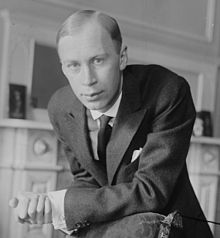
Never Mind Stalin, What About Seryozha? - 60 years since Prokoviev died

Sergei Prokoviev died 60 Years ago


Sergei Sergeyevich Prokofiev ( 23 April 1891 – 5 March 1953) was a Russian composer, pianist and conductor who is probably best known, in Sunderland at least, as the composer of the ballet Romeo and Juliet – from which "Dance of the Knights" is taken ("The Apprentice" theme tune and, more importantly, the music that is played at the Stadium of Light before the start of each football match)

Prokofiev died at the age of 61 on 5 March 1953, the same day Joseph Stalin's death was announced. With the national outpouring of grief over Stalin's death, Prokoviev's death went unnoticed by the general population for a long time afterwards.  He had lived near Red Square, and for three days the throngs gathered to mourn Stalin, making it impossible to carry Prokofiev's body out for the funeral service at the headquarters of the Soviet Composer's Union. He is buried in the Novodevichy Cemetery in Moscow.  This is a picture I took of his grave in 2002.  As a Sunderland AFC fan, I felt it important to make a pilgrimage to his grave, to mark my respects to the composer of the  such atmospheric and stirring music which we have enjoyed at the Stadium of Light since 1997.


Incidentally, it's obviously 60 years since Stalin's death.  The Moscow Times has an interesting article on the continuing influence or legacy of Stalinism in Russia:

http://www.themoscowtimes.com/news/article/stalin-lives-on-60-years-after-death/476444.html#ixzz2Mm31KrWM

The article cites as examples: the Moscow Metro, the seven sisters skyscrapers, “It’s the architecture of a totalitarian utopia,” with monumental scale, expensive decor and elements of historical styles from classicism to Gothic, said Natalya Samover, head of Arkhnadzor, a group that promotes architectural preservation; as well as the language of politicians and bureaucrats, and also mentality and structure of the FSB - the successor to the KGB.