Monday, 23 June 2014

Back in the USSR Socks


A gift for a president who has everything.  I got these for my birthday recently off the mother-in-law, probably because of the number of USSR nostalgia posts of late.  She got them from the Beatles museum in Liverpool.


Sunday, 1 June 2014

Fast Food Russian Style - Invented 200 years ago


Perhaps not the best time to be talking about invading Russian troops, but I was just contemplating, or rather remembering, the origin of the word "bistro".  The informal dining concept of a bistro is obviously a French import, but it is not well known, with the exception of a few hundred million Russians of course, that the word bistro comes from the Russian adjective/adverb: "fast"/"quickly".

Following France's disastrous invasion of Russia in 1812, Napoleon was repelled by advancing Russian army and eventually defeated in 1814.  The invading Russian troops arrived in Paris desperate to be fed and watered.   A group of Russian soldiers were dining at La Mère Catherine in Montmartre, they asked to be served "bistro" (быстро; Russian: "quickly"), banging their fists on the table chanting this repeatedly. Thereafter, "bistro" became a description of a restaurant where you could get food or drink quickly.

La Mère Catherine in Monmartre was founded in 1793, and is one of the oldest restaurants in Paris. A plaque at its entrance provides the etymology of the word "bistro" describing the above occasion which occurred on 30 March 1814.

Friday, 30 May 2014

Novy Arbat - back in the USSR


Given all the media talk of recreating the USSR, here is a picture of Kalinin Prospekt (now Novy Arbat) in downtown Moscow - with the building lights  displaying the letters CCCP(pronouced es es es er) - USSR. I love the layout of this street and the architecture, although some of the buildings are starting to look a bit shabby.  Here is a collection of photos of Novy Arbat:

http://davesrussiapagephotos.blogspot.co.uk/2014/05/novy-arbat-kalinin-prospekt.html

Friday, 23 May 2014

25 Years Ago - Socialist Property Exappropriated


I'm not sure at what point I thought it would be a good idea to smuggle goods out of the Soviet Union, but my stomach told me exactly when I realised it was a really bad idea - at the point I handed over my luggage and went through security at Leningrad's Pulkovskaya airport.  Feeling sick to the pit of my stomach, I really wished that I hadn't attempted to smuggle a Soviet Army and Soviet Navy belt buckle inside a tea caddy - in a tea caddy not unlike the one I described in an earlier post: http://blog.therussiahouse.net/2013/09/krasnodarsky-chai-tea.html.  

I had long wanted a Red Army belt buckle, and could have bought one from any one of the many black marketeers on the streets of Moscow and Leningrad on a number of occasions; but I had always passed up those opportunities on the basis that it was illegal to export them from the Soviet Union. I had also been told that the buckles were made from gun metal and would therefore set off the metal detectors at the airport - so you couldn't wear one as a belt and conceal the buckle with your jumper.   After buying some Russian tea which came in a metal tea caddy, I hit upon the idea of emptying the tea into a plastic bag and replacing the contents of the caddy with a belt buckle - brilliant!  I could now purchase my long coveted Red Army belt buckle; hell, why not go daft and get a Soviet Navy belt as well? 

So, with much trepidation I queued at the check-in knowing I had foolishly stashed not one but two belt buckles in an empty tin hidden in my suitcase.  It was not until the pilot announced we had left Soviet airspace did my arse stop twitching. Despite my relief the usual cheer which greeted such an announcement still pissed me off though.


Thursday, 22 May 2014

Greatest catastrophe of 20th century

...was the collapse of the Soviet Union. Putin said this once apparently. No he didn't you idiots (and I don't mean you, readers!). What he actually said was the collapse of the Soviet Union was the "greatest geopolitical tragedy of the 20th century".  The omission of "geopolitcal" alters the meaning and context of what he said; in this context, the word "greatest" means "largest in geographic area".

It's a line frequently trotted out in the Western media and top US politicians, more so since the Ukraine crisis has unfolded. The Ukrainian Prime Minister Arseniy Yatsenyuk even uttered this tripe the other day.

We certainly seemed to have returned to a Cold War footing - especially on the propaganda front. Back in the eighties, I remember Mikhail Gorbachev making a speech about Afghanistan which was taken out of context and widely misquoted. He said something along the lines of "imperialism has turned Afghanistan into a bleeding wound"; he was laying the blame squarely at the door of the Americans and their support of the Mujhadeen in opposing the Soviet occupation. But this was shortened, taken out of context and presented as an admission that "Afghanistan has become a bleeding wound".  It was not what the Soviets wanted either the world or it's own people to believe was happening in Afghanistan, and it completely changed the meaning of what he had said.  Even so, this was seen as a frank admission that things were not quite as they seemed in Afghanistan or a tacit acknowledgement that the Soviet Union was mired in its own "Vietnam". After all, "glasnost" - openness  - was the policy of the day.

Similarly, Putin's statement is often misused. It's interpreted that he somehow bemoans the loss of the Soviet Empire, the loss of Russia's power & status in the world, and his current actions can be explained by his desire to restore Soviet borders for the Russian federation, or to recreate the Soviet Union, or even to return to communism. Of course, his KGB background is often mentioned when propagating this nonsense.

The collapse of the Soviet Union in 1991 and the separation of the territory of 15 Soviet republics into newly independent countries was accompanied by economic hardship, hyperinflation, collapse of social protection, rise in organised crime, unemployment, brain drain, and complete economic dislocation (the Soviet Union was a centrally planned economy with all sectors, infrastructure and transport links very much interconnected and interrelated. The Soviet Union's vast geographically distance economy was controlled, albeit imperfectly, by banks of supercomputers whirring away on Prospekt Marx in downtown Moscow - home to the state planning body Gosplan (the building now houses the State Duma a Russia's parliament).

The system wasn't working effectively in many areas, but the breakup of the Soviet Union destroyed the planning system and fractured industry and infrastructure - eg how do you run a railway if your trains have been commandeered by newly independent countries, who owns the tracks, who owns the trains, who marshals the train service?

The period was also accompanied by considerable political upheaval  as new institutions state power structures had to be developed very rapidly and often from scratch:  legislature, executive, parliament, political parties, legal framework, other levers of power and democratic institutions- simultaneously across the vast territory of the former USSR.  Yelstin's power struggle with the Russian parliament which ended with the army shelling the White House - the building housing the Russian Parliament - is a prime example of the consequences of the the political collapse: political stalemate resolved in violent and fatal fashion.  But in some former republics, the power struggles were more violent in character, with some verging on civil war.  Edvard Schevardnadze, first President of Georgia, felt the harsh reality of the geopolitical catastrophe, following the collapse of the USSR, when he was holed up in a bunker during a Georgia's civil war in the early nineties - As the former foreign secretary of the second most powerful country in the world and, at the time, President of Georgia,  he must have thought "where did it all go wrong?" as the shells rained down around him in that bunker.

I think that in Putin's view, the geopolitical catastrophe is a historical fact - it has occurred, it can't be undone.  It may be possible or expedient even to right some "historical wrongs", but I don't think there is any appetite, desire, motivation to restore the borders of the Soviet Union.  Politically, he has presented himself as the only alternative to the wild Nineties - an antidote to the Yeltsin era, and has been successful in restoring the prestige (domestically at least), stability and power of the Russian state.   The collapse of the USSR, influences his approach to building power structures in order to control the levers of the economy and the state; he has resurrected many Soviet symbols, including the Soviet National Anthem (same music - different words), but restoring the USSR is not on his radar.  For example, Belarus - the bankrupt, corrupt, dictatorship of the former Soviet republic Belorussia would love to join Russia; it has courted Russia for many years, and Putin/Russia  has consistently rejected their advances.  In the Baltic countries, Latvia and Lithuania in particular, the sizable Russian speaking population has been discriminated against, repressed, deprived of rights for 20 odd years without any attempt by the Russian state to annex part of that territory on the pretext of protecting the rights of ethnic Russians.

The thing is, US politicians should know all this.  Fiona Hill of the US Brookings Institution has often challenged this red herring in her books and lectures (Putin's view that the Soviet Union collapse was a tragedy).  Both Fiona and this respected institution have been advising the US Government at the highest levels for years on Russian affairs, so it is inconceivable that US politicians don't know that they are spouting disingenuous crap.


New Cold War May Emerge in Ukraine Crisis, Medvedev Says | Johnsons Russia List

New Cold War May Emerge in Ukraine Crisis, Medvedev Says | Johnsons Russia List


Russia is being pulled into a new Cold War with the U.S. and its allies, who are using economic warfare reminiscent of the Soviet Union under Leonid Brezhnev, Russian Prime Minister Dmitry Medvedev said.

Wednesday, 14 May 2014

Hotel Moscow, Stolichnaya Vodka Label


Hotel Moscow - rebuilt version. 
Following my post last week http://blog.therussiahouse.net/2014/05/stolichnaya-vodka-label.html about the redesign of the Stolichnaya Vodka label, I though I would post a few pictures of the Hotel Moscow.  As I mentioned, this hotel was demolished and rebuilt to the same design - a process which is common in Moscow as described in my post of http://blog.therussiahouse.net/2013/06/moscow-hotel.html.  this post highlights the dubious practice of preserving the architectural heritage by creating facsimiles of original buildings (with lucrative contracts for demolition and reconstruction awarded in the process.

Hotel Moscow in January 1993.  
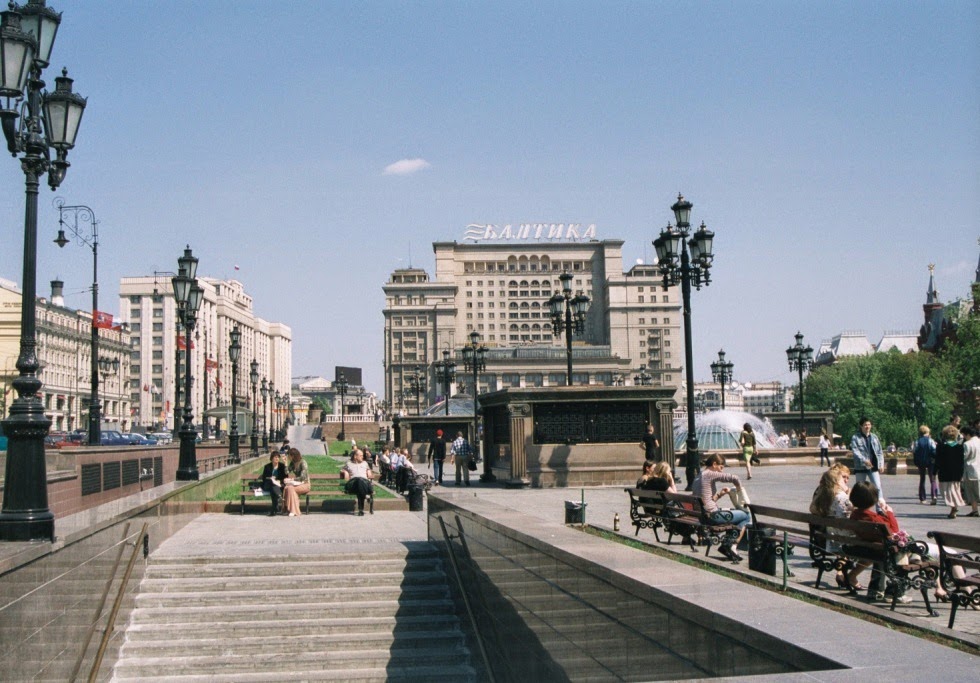
The Moscow hotel was built in the 1930s and is situated on Manezh Sqaure (its original name before being renamed in 1967 "50th Anniversary of the October Revolution" square.  60th Anniversary.  Stalin approved two separate designs  for the side blocks, the architects were not sure which design to use, so the hotel was constructed using both designs, thereby giving the hotel a clumsy, ill-proportioned facade.   As you can see in the above photograph from 1993, the square was not pedestrianised as it is now.  There was a vast expanse of tarmac in front of the hotel, which was flanked by two busy roads making it accessible only by a pedestrian tunnel.  In the 1990, the whole area was pedestrianised (except for the road in front of the Hotel National at the bottom of Tversakaya available for vehicles).  A large,multi-level underground shopping centre was created here with fountains, gardens restaurants and bars on the exterior - running the length of Alexander Gardens (Alexandrovsky Sad)


Manezh Square May2002. 


July 2003 - Before demolition commences. 

July 2003 - Before demolition commences. 

Taras Schevchenko - Ukrainian poet

Me and Taras Schevchenko
Born 9 Match 1814, Taras Schevchenko was a Ukrainian poet, writer, artist, public and political figure, as well as folklorist and ethnographer.

Shevchenko dreamed of a Ukraine that would be free of the stifling rule and censorship of the Russian Tsarist Imperial government. Some of Shevchenko's works were also censored by the Soviet Union. Shevchenko was not only a national poet of Ukraine he was also a universal poet. He defended the rights of all peoples to freedom, of human dignity, of women, of Jews, and stressed the importance of education, tradition and heritage. In addition, the renaissance of the Ukrainian language since 1991 is a tribute to Shevchenko's role as the founder of the modern literary Ukrainian language.

Here is his statue which stands in front of the Ukraine Hotel in Moscow.

Tuesday, 6 May 2014

Stolichnaya Vodka Label redesigned

I spotted a bottle of Stolichnaya in my local supermarket and I noticed that the label has been redesigned. The building  depicted on the bottle is The hotel Moscow in Moscow, on Manezh Square just off Red Square. Now I know the original Hotel Moscow at this location has been demolished and a replica built in its place, but I'm pretty sure they used the exact same design and dimensions - they didn't make it narrower.   The image on the "Stoli" label looks nothing like the Hotel Moscow now - it looks more like the Vermont hotel in Newcastle. 

Stoli?! I hate Stolichanaya being called Stoli! although, I do admit that find it marginally more acceptable than an incorrect pronunciation of Stolichnaya where the stress is placed on the second last syllable - stolichn-EYE-ya. The correct pronunciation is with the stress on the "i" as in stalEECHnaya (forgive my ignorance of pronunciation notation). But I am willing to let that that go as well. I do, however, become apoplectic with rage when someone, say a bartender, corrects MY pronunciation. LISTEN - IT'S stalEECHnaya, a feminine adjective from stalEETsa (stolitsa) the Russian feminine noun for "capital"!


Tuesday, 29 April 2014

Back in the USSR

25 years ago, I could have bought this album for a fiver.   Paul McCartney released this album  CHOBA B CCCP (s'nova v sssr) on the Soviet Melodiya label as a special edition for release solely in the Soviet Union.  The Beatles were extremely popular in the Soviet Union (and continue to be in Russia) despite their recordings not being available from legitimate sources during communist times.  Following the collapse of the Soviet Union, Choba B CCCP was given a worldwide release in 1991.

A black-marketeer (fartsovki, I think they were called) offered to sell a copy to me for £5 in a department store on Moskovskaya Prospekt not far from the Pulkovskaya hotel in St Petersburg. 

At the time, I considered McCartney to be a "talent-less has-been", declared him as such and refused the offer (saying to my mate "what do I want to buy that shite for?") .  Back in England, the album had become a collectors item and was being sold for up to £150!  What do I know?

I quite likes the Beatles now, and recognise their considerable talent and contribution to music. But back then, it was only 8 years after I had been hauled in front of the head teacher at school for a bollocking over my music exam paper.  They disliked my answer to the question "name two songwriters from the Beatles". My answer was "John Lop and Paul McCockroach". 


Thursday, 24 April 2014

RT - Russia Today News Channel

I have an admission: I occasionally like to watch RT the Russian state English language news channel which is free to view in the UK on Freeview.  It it is good to get some alternative perspectives on world events and sometimes to see things in other countries which are not necessarily covered by upon in western media for whatever reasons.

But, you have to wonder about its editorial bias and question the credibility of its output when they give a platform to the likes George Galloway on the station -  someone who presents their own program - Sputnik.  Former MP, leftwinger and Trotskyist, Dave Nellist, was also on the other night being interviewed at length.  RT seems to give a lot of airtime for a rag-tag of rent-a-mob, anti-capitalist, leftwingers.  Sometimes I think they focus too much on the negative aspects of the western societies, poverty crime, demonstrations - there is too much handwringing and schadenfreude and self-righteous tone to their reporting style.

It's odd that it has a left wing bias in its coverage of western countries when in terms of economic policy and authoritarianism Russia is on the right wing and anti-liberal.   RT seems to give voice to an odd alliance of left wingers, conspiracy theorists and anti-US and anti-capitalist academics.  

Has RT forgotten that Russia is a capitalist economy nowadays?  On the basis of how much the state accounts for a country's GDP, the UK and France are more socialist by comparison.

Having said that, the rampant Russophobia we have been seeing the western media over recent years and especially since the start of the Ukraine crisis, you would think that the west had forgotten that Russia was no longer communist and the Cold War finished nearly 25 years ago!

Nevertheless, RT does have some good programmes.  Peter Lavelle's Crosstalk is good (but watch out for the dodgy academics); the Kaiser report is entertaining of only they could turn down his rabid winy voice; and occasionally they have some good documentaries on aspects of Russian life you would not normally get to see.

Wednesday, 23 April 2014

Happy St George's Day Moscow!


...... from England and Newcastle.  England and Moscow share a patron saint, St George, whose day is celebrated today April 23rd.  In Newcastle, we have a statue of Saint George which stands in Old Eldon Square.  Incidentally, nearby the statue is a bench which dedicated to the Russian Convoy Club in Newcastle - honouring those who took part in the Arctic Convoys during World War II.


Tuesday, 22 April 2014

Joe Biden visits Ukraine - says nothing useful

Just heard him on Radio 4, PM news programme.  He needs winding up - how many times is he going to say the same thing twice  . . really slowly      for.   dramatic.    effect.  He said something about Ukraine not being reliant on Russian gas - I think Russia would probably like that too, or at least some kind of payment for gas delivered.  Yeah, let them pay world prices for their gas . . . not sure that would go down too well in Ukraine.   What a tit.

Thursday, 17 April 2014

VDNKh - Moscow's Economic Achievements Park to return to former glory

The All-Russian Exhibition Center (VVTs) in Moscow, famous for its Soviet-era pavilions representing the various republics of the Soviet Union, is undergoing a major facelift in a bid to become "beautiful and comfortable," according to the company that manages the property.

It has been rumoured that it is to revert to its Soviet-era name: Exhibition of Achievements of the National Economy (Russian: Выставка Достижений Народного Хозяйства Vystavka Dostizheniy Narodnovo Khozyaystva).


Here is a Lego model of the People's Fountain of Friendship which features in the grounds of the exhibition centre. I saw this Lego model in the Centre for life in Newcastle as part of a Lego exhibition comprising famous buildings / landmarks from around the world - I thought it was a bit strange that out of all of the most famous buildings in Moscow they chose to create a model of a relatively obscure fountain.

Friday, 4 April 2014

Newcastle fights back against Russian occupation

Following the announcement on Tuesday of Russia's potential annexation of the city of Newcastle upon Tyne,  anti-Russian protest murals have appeared around the city. 
(see http://blog.therussiahouse.net/2014/04/russia-to-annex-newcastle-upon-tyne.html)

Scotswood Road graffiti

Wednesday, 2 April 2014

Vladimir and Lyudmila Putin are finally divorced.

The art of Kremlinology is not dead.  Keen analysts of the Russian government website have noticed a change in Vladimir Putin's marital status - gone is the reference to his being married to Lyudmila Aleksandrovna Putina.  His spokesperson, Dimitri Peskov, explains that this is because they are now divorced.  They officially separated a year ago in 2013 following a number of years of speculation and rumours because Lyumila had not been seen in public accompanying her husband. 

When Lyudmila (and Vlaidimir) Putin visited the UK in 2003, The Times newspaper published Mrs Putin's Ukho (fish soup) recipe (which I kept). The dish is called Ukho, a traditional Russian fish soup, which literally translates as "ear" soup . It could be said that she no longer has the ear of Putin, so to mark the sad occasion of their divorce, here is Mrs Putin's fish soup recipe that Vladimir won't be enjoying any more:


INGREDIENTS 

1 pike-perch 
1 pike 
1 potato 
1 carrot 
2 onions 
3 cloves garlic 
1 bunch parsley, coriander and fennel leaves 
2 eggs Cinnamon, 
curry powder, 
saffron 
4 tomatoes 
Orange peel 
4 sticks celery 
4 spring onions 
A cup of vinegar, 
lemon juice or white wine 

Gut and remove the gills from the pike-perch and pike, leaving their scales on. Marinade them for one and a half hours in “sour water” (vinegar, lemon or white wine). Then remove the head, tail and skin (with the scales still on) and place them in cold water, leaving the fish to one side. Add salt, a whole potato, a carrot, onion, three cloves of garlic in their skin, some parsley stems (remove the leaves for later) fennel and saffron. Bring to the boil and simmer on a low heat for one hour. Then drain, keeping the stock. Cut the pike-perch into strips 3cm wide and put the pike and the onion from the stock through a mincer. Add two egg-yolks, pinch of cinnamon, curry powder and saffron. Mix together and roll the mixture into balls about 10cm in diameter. Plunge tomatoes into boiling water for 15 seconds, then skin and cut into pieces. Finely chop celery (removing leaves), spring onions and an ordinary onion and sauté in olive oil. Finely chop parsley leaves, coriander and some orange peel. Bring stock back to the boil and one by one add the fish balls made from the pike and strips of pike-perch and boil for ten minutes. Add tomato, sautéd celery, spring onion and onion, orange peel, parsley and coriander as well as your favourite spices (a little curry powder and some saffron). Bring to the boil, take off the heat and allow to cool a little before serving. 

Serves four

Tuesday, 1 April 2014

Russia to annex Newcastle Upon Tyne

Russian tricolour flies over Newcastle City Centre
The Russians are coming to Newcastle! Following the events in the Crimea, it seems Russia may have its sights on territory in the UK, in particular, Newcastle City Centre.  Durak Aprelski, the self appointed spokesman and leader of the Emergency Committee for National Reconciliation of Russian Diaspora in Newcastle has announced today that the city of Newcastle upon Tyne has seceded from the UK and formally requested membership of the Russian federation.   

This has been done in order to correct historical injustices and anomalies, and represents the popular will of the circa 4000 population of ethnic Russians in Newcastle.

According to Durak, the legitimacy of Russia's historic claim on the territory of Newcastle city lies in the area around Stowell Street, known locally as China Town, which lies alongside the city's walls. These walls are part of an ancient fortress, or "Kremlin". The words China Town is a literal translation of the Russian words Kitai Gorod - which is the site of an old fortifications of the original Kremlin in Moscow. He believes that this area of the city derives its name not from the numerous Chinese restaurants located here but because is was once the site of a wooden Kremlin (Kitai Gorod) belonging to the Ancient Rus - before the existing city walls were built.   

Following accession to the Russian Federation, Durak Aprelski states that the rights and languages of all other nationalities in the city will be respected and protected, but warns that there will be a period of Russification. Until Newcastle is formally accepted as part of Russia, a State of Emergency has been declared and the Emergency Committee has drawn up a list of key buildings which will be taken over or renamed:

1.Theatre Royal will henceforth be known as the Bolshoi Theatre, and for the duration of the State of Emergency, performances of Swan Lake will be shown instead of the advertised schedule.


2.All Saints Church will be converted to a hotel and renamed Ukraine Hotel.


3. BT Hadrian Exchange Building to become the Telegraph Agency media centre known as TASS


4. The Central Arcade will become the State Universal Store (Gosudarstveny Universlany Magazin - GUM)


5. The shop "Cruise" on Princess Square to house the Palace of Congresses


6. Crudass Park to be renamed Izmailovsky Park


7. Newgate Street to be renamed Novy Arbat Street,  however, the territorial integrity and right of self-determination of the Malgosia's Polish shop in the Newgate Centre will be respected.


8. New Bridge Street to become Zubovsky Boulevard.


9. Police Station Market street to become a toy shop - Children's World: Detsky Mir


10.  Carliol House will become the Ministry of Defence for the People's Militia and The Emergency Committee.


On a more positive note, Durak Aprelski has ordered an immediate revamp of the Metro - initially installing chandeliers at city centre stations and having trains run every minute to all destinations.

People's Militia in training