What's going on? First we have General Richards, former UK army chief, calling for a rapprochement with Russia and expressing pro-Russian views, now Paddy Pantsdown is at it! Sorry Lord Ashdown, but you will be forever known by your classic Sun-headline-based moniker (well, by me, at least).
Former marine, Lord Ashdown, states in the Times today, Tuesday 30th September 2014, that "Russia is an essential ally in the fight against jihadism. The alternative is a global religious war". He acknowledges that "Sunni jihadism is roaring away in the Russian Islamic republics of Dagestan and Chechnya, almost as much as in Iraq and Syria. We in Europe may be concerned about jihadis returning from the battlefield. But Russia is one of the battlefields."
Putin has been saying this for years - since the first war in Chechnya in 1994 - and long before 9/11. It's about time the west, especially Obama and the US administration, acknowledged this and stopped with their ridiculous policy of sanctions and ostracism against Russia.

Tuesday, 30 September 2014


Former General supports Russian position over Crimea
Last week's Sunday Times, 28 September 2014, contains an interview with one of Britain’s former top soldiers, General David Richards, who retired last year. The article was essentially discussing the crisis in Iraq and Syria, and Friday's vote in the House of Commons to commit the UK's armed forces to airstrikes against the terrorist group ISIL in Iraq, but in it he expresses some refreshingly honest, and accurate views on Russia, which run counter to the prevailing Russophobia in the western press.
“I don’t want to sound an apologist for Russia, but think Falklands, think Cuba, and you begin to understand what Russia feels about Ukraine.....it’s been a part of their country for hundreds of years." In respect of Crimea, he refers to the annexation as Putin's "cleverly executed plan"I do tend to think that you are on dodgy ground when you try to establish borders and rights to territory on the basis of a arbitrarily selected point in time (or a point in time chosen to support your case), especially in the case of historically contested territory and fluctuating borders of nation states, kingdoms, princedoms, tribes. However, General Richards goes on to state:
"Crimea is Russian. The Russians, British and French went to war over Crimea 170 years ago. The idea that Crimea was ever going to be allowed by Russians to be part of Ukraine, or a Ukraine that was hostile, was cloud-cuckoo-land. And from a purely military sense, it was a rather cleverly executed plan."On the events Ukraine, he expresses a more honest opinion than you usually read in the western press; he asks:
"are we really certain those protesters in the early days were properly representative of the majority of Ukraine? There were certainly some dodgy elements, and a president who was democratically elected was kicked out, however much you don’t like him."He goes on to express his worry, which I believe is quite an honest assessment of western actions in Ukraine, Georgia, Syria and elsewhere: we get involved, we give encouragement, moral support, but we don't follow through; we keep encouraging people to get to the top of the hill but don't do enough to get them there. Perhaps like Sisyphus in Greek mythology: as a punishment for chronic deceitfulness, Sysyphus is compelled to roll an immense boulder up a hill, only to watch it roll back down, and to repeat this action forever.
Wednesday, 17 September 2014
Russia's opposition to action against Syria
Up until a few months ago I thought that ISIS was just a pub along Silksworth Row in Sunderland. It turns out that an Islamic extremist group of that name has emerged which is more barbaric than Al Quaeda. It is a well-armed, well-organised and well-funded terrorist organisations intent on creating an Islamic State in Syria and Iraq and has variously been called ISIS, IS and now ISIL. Whatever it is, it's not a state and it's not Islamic.
Russia has been warning the west for years - long before 9/11 - about the rise of Islamic extremism, having experienced it on its own soil. The Russian position has consistently been to ask who would govern Syria if Assad is deposed, and to point out that by arming the rebels, you fuel Islamic extremist groups, making matters worse. Whatever Russia's motivation and allegiance are in this, it is nevertheless a reasonable question to ask.
Russia has been warning the west for years - long before 9/11 - about the rise of Islamic extremism, having experienced it on its own soil. The Russian position has consistently been to ask who would govern Syria if Assad is deposed, and to point out that by arming the rebels, you fuel Islamic extremist groups, making matters worse. Whatever Russia's motivation and allegiance are in this, it is nevertheless a reasonable question to ask.
I have previously viewed Russia's support for Assad, and both Russia and China's opposition to intervention and the military action against Assad's murderous regime, to be morally reprehensible, self-serving, obstructionist and realpolitik at its worst; but, given the rapid rise of this radical terrorist organisation, comprising circa 30,000 fighters from Syrian rebel groups, the Russian position seems remarkably prescient and sensible.
There is now talk in some western circles about engaging in dialogue with Assad with a view to assisting him crush these rebels. There was the meeting of foreign ministers this week, which included Russia's Sergei Lavrov, on the pressing need to do something about the ISIS/IS/ISIL. On the news this morning, I heard that the US was taking military action to protect Syria's border.
What's going on? Its just like the shifting alliances in the perpetual war depicted in Orwell's novel "1984".
There is now talk in some western circles about engaging in dialogue with Assad with a view to assisting him crush these rebels. There was the meeting of foreign ministers this week, which included Russia's Sergei Lavrov, on the pressing need to do something about the ISIS/IS/ISIL. On the news this morning, I heard that the US was taking military action to protect Syria's border.
Friday, 22 August 2014
Prince Andrei Kurbsky letter to Ivan the Terrible
"To the Tsar, exalted by God, who formerly appeared most illustrious but has now been found to be the opposite! May you, o Tsar, understand this with your leprous conscience .... You have persecuted me most bitterly; you have destroyed your royal servants and spilled the blood of innocent martyrs ... You have answered my love with hatred, good with evil, and my blood - spilt for you - cries out against you to The Lord God!"
Taken from the excellent book by Martin Sixsmith: Russia A 1000 year Chronicle of the Wild East, which I am currently reading. I'm only up to Chapter 8, but what I've read so far is fascinating - and it seems there are so many historical parallels with Putin's Russia in respect of his return to authoritarianism, centralised authority, powerful state whose interests must be place higher than the individual, immense power concentrated in the hands of one individual; and the manipulation and control of oligarchs.
The quote above is from a Prince who fell foul of the Tsar Ivan the Terrible and corresponded with the Tsar while in exile. I liked this quote not because of its relevance to modern Russia but because it has some personal resonance for any loyal, hard-working employee who has suffered from a capricious, bullying, incompetent, unstable boss bent on destroying their career.
The quote above is from a Prince who fell foul of the Tsar Ivan the Terrible and corresponded with the Tsar while in exile. I liked this quote not because of its relevance to modern Russia but because it has some personal resonance for any loyal, hard-working employee who has suffered from a capricious, bullying, incompetent, unstable boss bent on destroying their career.
Wednesday, 20 August 2014
12 Faces of President Putin - Calendar 2002

Here is something from the archives, for all those Kremlinologists, Putinologists, amateur psychologists and so-called experts on Russia: extracts of a 2002 calendar featuring the 12 faces of President Putin.
His myriad of facial expressions no doubt provide a huge source of information for Western security analysts, but I've often wondered whether he deploys them consciously and purposefully to manipulate his interlocutors or to provide disinformation for analysts. The bored, petulant schoolboy look is Obama's favourite (http://blog.therussiahouse.net/2013/09/putin-is-tosser.html)
The calendar was based on some paintings made early in Putin's first term as President when his popularity ratings were, as now, "sky high".

The scanned images here were originally published in The Times with, I think, the following: "The most sought-after Christmas present in the Kremlin this year is a 2002 calendar featuring the 12 faces of President Putin.
Although criticised by some Russians for placing restrictions on the media, and for getting too close to the United States too fast, he has sky-high popularity ratings and is widely admired for restoring national pride in the nearly two years since he took over from Boris Yeltsin. Unlike Mr Yeltsin, who, despite his defence of democracy, eventually became a figure of fun for his chaotic and sometimes drunken management of post-Communist Russia, Mr Putin is seen as upright, with a skilful and assured touch on foreign affairs and the economy.
The calendar reflects a growing campaign to show that he is not only a strong leader or vozhd in the Russian tradition —both Tsarist and Communist — but that he also has a human side that belies his image as a hard-faced former KGB agent.
The pictures, painted by Dmitri Vrubel and Viktoria Timofeeyeva, a husband and wife team, were not officially commissioned by the Kremlin and were based on photographs rather than sittings.
Mr Vrubel said that this was deliberate because they wanted to pin down certain expressions and match them to months, whereas when a subject sat for a portrait their expression kept changing. Mrs Timofeeyeva said: "In the end I felt we were painting a friend or a neighbour, not a leader who inspires fear."
The paintings had unofficial approval and were being bought by Kremlin officials for their offices and to give as gifts, Mr Vrubel said. A senior official has given the calendar to Mr Putin, together with the original oil painting of the December portrait. which shows the Russian leader in a thoughtful pose. "He apparently liked it very much" Mr Vrubel said. The President’s office has also bought the original of the calendar’s cover portrait— in effect, a thirteenth pose — which shows Mr Putin, a former judo champion, sitting cross-legged in his judo clothing.
Nezavisimaya Gazeta noted that the calendar was in contrast to the idealised pictures of Mr Putin available in Moscow bookshops, which were a throwback to the airbrushed portraits of Soviet times.
THE "manly chest" of President Putin, exposed in a judo pose was proving popular with many women, Viktona Timofeeyeva, who painted the studies with her husband, Dmitri Vrubel, said. She said that many women found Mr Putin attractive, particularly in the calendar’s cover portrait, which went on display at an exhibition that opened in central Moscow."

Tuesday, 29 July 2014
Peter Hitchens on Flight MH17 Tragedy
Peter Hitchens has got this spot on. The EU and NATO stir up trouble in the Ukraine (and other places as well e.g. Georgia) then walk away when things get difficult. The causal link is more EU than Putin.
http://www.dailymail.co.uk/debate/article-2698652/PETER-HITCHENS-Mourn-victims-dont-turn-one-tragedy-global-catastrophe.html
http://www.dailymail.co.uk/debate/article-2698652/PETER-HITCHENS-Mourn-victims-dont-turn-one-tragedy-global-catastrophe.html
"Those who began the current war in Ukraine – the direct cause of the frightful murder of so many innocents on Flight MH17 on Thursday – really have no excuse.There is no doubt about who they were. In any war, the aggressor is the one who makes the first move into neutral or disputed territory.And that aggressor was the European Union."
Monday, 21 July 2014

Thursday, 17 July 2014
Photo exhibition - The Side Gallery Newcastle

Tucked away up an alleyway off Newcastle's quayside, The Side Gallery & Cinema truly is a hidden gem. I don't come here often enough, despite the fact that I run past here most days. When out for a run today, I was passing here and remembered I had seen an advert for their current exhibiution " LEGACY: Russia, Ukraine, Georgia, & The Caucasus", so I decided to pop in for a look.
The exhibition runs until Sunday 20 July 2014 - so only a few days left!
It is an exhibition of photos by a number of photgraphers: George Georgiou, Lucia Ganieva, Mila Teshaieva, Rafal Milach, Justyna Mielnikiewicz, Donald Weber, Olga Kravets, Maria Morina, Oksana Yushko, Alexander Chekmenev; and covers the former Soviet Union republics and their "Struggles for independence and identity take place against the intensifying backdrop of a geo-political battle between Russia and European Union. Through a series of imaginative landscapes the exhibition explores shared histories, isolation and engagement, tradition and the desire for modernity"

Wednesday, 9 July 2014
25 Years ago - Congress of Peoples Deputies created
 |
| Andrei Sakharov - the congress's most famous deputy - calls for a multi-party system |
Soviet Space Shuttle, Buran, Moves to All Russian Exhibition Centre

The life-sized prototype of the Buran spaceship — the Soviet's copy of the Space Shuttle was moved from Moscow's Gorky Park to the All-Russian Exhibition Centre (formerly VDNKh) which has been getting a bit of a face lift of late.
http://blog.therussiahouse.net/2013/11/buran-triumph-and-tragedy-of-russian.html
http://blog.therussiahouse.net/2014/04/vdnkh-moscows-economic-achievements.html
http://www.themoscowtimes.com/news/article/monument-to-soviet-space-program-put-out-to-pasture-in-moscows-vdnkh/503050.html
Best of 1950s Soviet Design Exhibition - London
 |
| It's Time for a Grand Housewarming' |
THE GALLERY FOR RUSSIAN ARTS & DESIGN (GRAD) in London (3-4a Little Portland Street London W1W 7JB) has an exhibition on at the moment about Soviet design in the 1950s onwards. This is the blurb from their website.
WORK AND PLAY BEHIND THE IRON CURTAIN
20 JUNE — 24 AUGUST 2014
FREE ENTRY
Curated by ELENA SUDAKOVA and ALEXANDRA CHIRIAC
Exhibition design by CALUM STORRIE and KATYA SIVERS
Photographs by ROMAN SUSLOV and SSK PHOTOGRAPHY
Work and Play Behind the Iron Curtain brings together over fifty key objects featuring the quirky, colourful and often charming design style that emerged from the 1950s in the Soviet Union.
http://www.grad-london.com/whatson/


Monday, 23 June 2014
Back in the USSR Socks

A gift for a president who has everything. I got these for my birthday recently off the mother-in-law, probably because of the number of USSR nostalgia posts of late. She got them from the Beatles museum in Liverpool.
Tuesday, 10 June 2014
Sunday, 1 June 2014
Fast Food Russian Style - Invented 200 years ago

Perhaps not the best time to be talking about invading Russian troops, but I was just contemplating, or rather remembering, the origin of the word "bistro". The informal dining concept of a bistro is obviously a French import, but it is not well known, with the exception of a few hundred million Russians of course, that the word bistro comes from the Russian adjective/adverb: "fast"/"quickly".
Following France's disastrous invasion of Russia in 1812, Napoleon was repelled by advancing Russian army and eventually defeated in 1814. The invading Russian troops arrived in Paris desperate to be fed and watered. A group of Russian soldiers were dining at La Mère Catherine in Montmartre, they asked to be served "bistro" (быстро; Russian: "quickly"), banging their fists on the table chanting this repeatedly. Thereafter, "bistro" became a description of a restaurant where you could get food or drink quickly.
La Mère Catherine in Monmartre was founded in 1793, and is one of the oldest restaurants in Paris. A plaque at its entrance provides the etymology of the word "bistro" describing the above occasion which occurred on 30 March 1814.
Friday, 30 May 2014
Novy Arbat - back in the USSR

Given all the media talk of recreating the USSR, here is a picture of Kalinin Prospekt (now Novy Arbat) in downtown Moscow - with the building lights displaying the letters CCCP(pronouced es es es er) - USSR. I love the layout of this street and the architecture, although some of the buildings are starting to look a bit shabby. Here is a collection of photos of Novy Arbat:
http://davesrussiapagephotos.blogspot.co.uk/2014/05/novy-arbat-kalinin-prospekt.html
Friday, 23 May 2014
25 Years Ago - Socialist Property Exappropriated

I'm not sure at what point I thought it would be a good idea to smuggle goods out of the Soviet Union, but my stomach told me exactly when I realised it was a really bad idea - at the point I handed over my luggage and went through security at Leningrad's Pulkovskaya airport. Feeling sick to the pit of my stomach, I really wished that I hadn't attempted to smuggle a Soviet Army and Soviet Navy belt buckle inside a tea caddy - in a tea caddy not unlike the one I described in an earlier post: http://blog.therussiahouse.net/2013/09/krasnodarsky-chai-tea.html.
 I had long wanted a Red Army belt buckle, and could have bought one from any one of the many black marketeers on the streets of Moscow and Leningrad on a number of occasions; but I had always passed up those opportunities on the basis that it was illegal to export them from the Soviet Union. I had also been told that the buckles were made from gun metal and would therefore set off the metal detectors at the airport - so you couldn't wear one as a belt and conceal the buckle with your jumper. After buying some Russian tea which came in a metal tea caddy, I hit upon the idea of emptying the tea into a plastic bag and replacing the contents of the caddy with a belt buckle - brilliant! I could now purchase my long coveted Red Army belt buckle; hell, why not go daft and get a Soviet Navy belt as well?
 So, with much trepidation I queued at the check-in knowing I had foolishly stashed not one but two belt buckles in an empty tin hidden in my suitcase. It was not until the pilot announced we had left Soviet airspace did my arse stop twitching. Despite my relief the usual cheer which greeted such an announcement still pissed me off though.
Thursday, 22 May 2014
Greatest catastrophe of 20th century
...was the collapse of the Soviet Union. Putin said this once apparently. No he didn't you idiots (and I don't mean you, readers!). What he actually said was the collapse of the Soviet Union was the "greatest geopolitical tragedy of the 20th century". The omission of "geopolitcal" alters the meaning and context of what he said; in this context, the word "greatest" means "largest in geographic area".
It's a line frequently trotted out in the Western media and top US politicians, more so since the Ukraine crisis has unfolded. The Ukrainian Prime Minister Arseniy Yatsenyuk even uttered this tripe the other day.
We certainly seemed to have returned to a Cold War footing - especially on the propaganda front. Back in the eighties, I remember Mikhail Gorbachev making a speech about Afghanistan which was taken out of context and widely misquoted. He said something along the lines of "imperialism has turned Afghanistan into a bleeding wound"; he was laying the blame squarely at the door of the Americans and their support of the Mujhadeen in opposing the Soviet occupation. But this was shortened, taken out of context and presented as an admission that "Afghanistan has become a bleeding wound". It was not what the Soviets wanted either the world or it's own people to believe was happening in Afghanistan, and it completely changed the meaning of what he had said. Even so, this was seen as a frank admission that things were not quite as they seemed in Afghanistan or a tacit acknowledgement that the Soviet Union was mired in its own "Vietnam". After all, "glasnost" - openness - was the policy of the day.
Similarly, Putin's statement is often misused. It's interpreted that he somehow bemoans the loss of the Soviet Empire, the loss of Russia's power & status in the world, and his current actions can be explained by his desire to restore Soviet borders for the Russian federation, or to recreate the Soviet Union, or even to return to communism. Of course, his KGB background is often mentioned when propagating this nonsense.
The collapse of the Soviet Union in 1991 and the separation of the territory of 15 Soviet republics into newly independent countries was accompanied by economic hardship, hyperinflation, collapse of social protection, rise in organised crime, unemployment, brain drain, and complete economic dislocation (the Soviet Union was a centrally planned economy with all sectors, infrastructure and transport links very much interconnected and interrelated. The Soviet Union's vast geographically distance economy was controlled, albeit imperfectly, by banks of supercomputers whirring away on Prospekt Marx in downtown Moscow - home to the state planning body Gosplan (the building now houses the State Duma a Russia's parliament).
The system wasn't working effectively in many areas, but the breakup of the Soviet Union destroyed the planning system and fractured industry and infrastructure - eg how do you run a railway if your trains have been commandeered by newly independent countries, who owns the tracks, who owns the trains, who marshals the train service?
The period was also accompanied by considerable political upheaval as new institutions state power structures had to be developed very rapidly and often from scratch: legislature, executive, parliament, political parties, legal framework, other levers of power and democratic institutions- simultaneously across the vast territory of the former USSR. Yelstin's power struggle with the Russian parliament which ended with the army shelling the White House - the building housing the Russian Parliament - is a prime example of the consequences of the the political collapse: political stalemate resolved in violent and fatal fashion. But in some former republics, the power struggles were more violent in character, with some verging on civil war. Edvard Schevardnadze, first President of Georgia, felt the harsh reality of the geopolitical catastrophe, following the collapse of the USSR, when he was holed up in a bunker during a Georgia's civil war in the early nineties - As the former foreign secretary of the second most powerful country in the world and, at the time, President of Georgia, he must have thought "where did it all go wrong?" as the shells rained down around him in that bunker.
I think that in Putin's view, the geopolitical catastrophe is a historical fact - it has occurred, it can't be undone. It may be possible or expedient even to right some "historical wrongs", but I don't think there is any appetite, desire, motivation to restore the borders of the Soviet Union. Politically, he has presented himself as the only alternative to the wild Nineties - an antidote to the Yeltsin era, and has been successful in restoring the prestige (domestically at least), stability and power of the Russian state. The collapse of the USSR, influences his approach to building power structures in order to control the levers of the economy and the state; he has resurrected many Soviet symbols, including the Soviet National Anthem (same music - different words), but restoring the USSR is not on his radar. For example, Belarus - the bankrupt, corrupt, dictatorship of the former Soviet republic Belorussia would love to join Russia; it has courted Russia for many years, and Putin/Russia has consistently rejected their advances. In the Baltic countries, Latvia and Lithuania in particular, the sizable Russian speaking population has been discriminated against, repressed, deprived of rights for 20 odd years without any attempt by the Russian state to annex part of that territory on the pretext of protecting the rights of ethnic Russians.
The thing is, US politicians should know all this. Fiona Hill of the US Brookings Institution has often challenged this red herring in her books and lectures (Putin's view that the Soviet Union collapse was a tragedy). Both Fiona and this respected institution have been advising the US Government at the highest levels for years on Russian affairs, so it is inconceivable that US politicians don't know that they are spouting disingenuous crap.
It's a line frequently trotted out in the Western media and top US politicians, more so since the Ukraine crisis has unfolded. The Ukrainian Prime Minister Arseniy Yatsenyuk even uttered this tripe the other day.
We certainly seemed to have returned to a Cold War footing - especially on the propaganda front. Back in the eighties, I remember Mikhail Gorbachev making a speech about Afghanistan which was taken out of context and widely misquoted. He said something along the lines of "imperialism has turned Afghanistan into a bleeding wound"; he was laying the blame squarely at the door of the Americans and their support of the Mujhadeen in opposing the Soviet occupation. But this was shortened, taken out of context and presented as an admission that "Afghanistan has become a bleeding wound". It was not what the Soviets wanted either the world or it's own people to believe was happening in Afghanistan, and it completely changed the meaning of what he had said. Even so, this was seen as a frank admission that things were not quite as they seemed in Afghanistan or a tacit acknowledgement that the Soviet Union was mired in its own "Vietnam". After all, "glasnost" - openness - was the policy of the day.
Similarly, Putin's statement is often misused. It's interpreted that he somehow bemoans the loss of the Soviet Empire, the loss of Russia's power & status in the world, and his current actions can be explained by his desire to restore Soviet borders for the Russian federation, or to recreate the Soviet Union, or even to return to communism. Of course, his KGB background is often mentioned when propagating this nonsense.
The collapse of the Soviet Union in 1991 and the separation of the territory of 15 Soviet republics into newly independent countries was accompanied by economic hardship, hyperinflation, collapse of social protection, rise in organised crime, unemployment, brain drain, and complete economic dislocation (the Soviet Union was a centrally planned economy with all sectors, infrastructure and transport links very much interconnected and interrelated. The Soviet Union's vast geographically distance economy was controlled, albeit imperfectly, by banks of supercomputers whirring away on Prospekt Marx in downtown Moscow - home to the state planning body Gosplan (the building now houses the State Duma a Russia's parliament).
The system wasn't working effectively in many areas, but the breakup of the Soviet Union destroyed the planning system and fractured industry and infrastructure - eg how do you run a railway if your trains have been commandeered by newly independent countries, who owns the tracks, who owns the trains, who marshals the train service?
The period was also accompanied by considerable political upheaval as new institutions state power structures had to be developed very rapidly and often from scratch: legislature, executive, parliament, political parties, legal framework, other levers of power and democratic institutions- simultaneously across the vast territory of the former USSR. Yelstin's power struggle with the Russian parliament which ended with the army shelling the White House - the building housing the Russian Parliament - is a prime example of the consequences of the the political collapse: political stalemate resolved in violent and fatal fashion. But in some former republics, the power struggles were more violent in character, with some verging on civil war. Edvard Schevardnadze, first President of Georgia, felt the harsh reality of the geopolitical catastrophe, following the collapse of the USSR, when he was holed up in a bunker during a Georgia's civil war in the early nineties - As the former foreign secretary of the second most powerful country in the world and, at the time, President of Georgia, he must have thought "where did it all go wrong?" as the shells rained down around him in that bunker.
I think that in Putin's view, the geopolitical catastrophe is a historical fact - it has occurred, it can't be undone. It may be possible or expedient even to right some "historical wrongs", but I don't think there is any appetite, desire, motivation to restore the borders of the Soviet Union. Politically, he has presented himself as the only alternative to the wild Nineties - an antidote to the Yeltsin era, and has been successful in restoring the prestige (domestically at least), stability and power of the Russian state. The collapse of the USSR, influences his approach to building power structures in order to control the levers of the economy and the state; he has resurrected many Soviet symbols, including the Soviet National Anthem (same music - different words), but restoring the USSR is not on his radar. For example, Belarus - the bankrupt, corrupt, dictatorship of the former Soviet republic Belorussia would love to join Russia; it has courted Russia for many years, and Putin/Russia has consistently rejected their advances. In the Baltic countries, Latvia and Lithuania in particular, the sizable Russian speaking population has been discriminated against, repressed, deprived of rights for 20 odd years without any attempt by the Russian state to annex part of that territory on the pretext of protecting the rights of ethnic Russians.
The thing is, US politicians should know all this. Fiona Hill of the US Brookings Institution has often challenged this red herring in her books and lectures (Putin's view that the Soviet Union collapse was a tragedy). Both Fiona and this respected institution have been advising the US Government at the highest levels for years on Russian affairs, so it is inconceivable that US politicians don't know that they are spouting disingenuous crap.
New Cold War May Emerge in Ukraine Crisis, Medvedev Says | Johnsons Russia List
New Cold War May Emerge in Ukraine Crisis, Medvedev Says | Johnsons Russia List
Russia is being pulled into a new Cold War with the U.S. and its allies, who are using economic warfare reminiscent of the Soviet Union under Leonid Brezhnev, Russian Prime Minister Dmitry Medvedev said.
Russia is being pulled into a new Cold War with the U.S. and its allies, who are using economic warfare reminiscent of the Soviet Union under Leonid Brezhnev, Russian Prime Minister Dmitry Medvedev said.
Wednesday, 14 May 2014
Hotel Moscow, Stolichnaya Vodka Label
 |
| Hotel Moscow - rebuilt version. |
 |
| Hotel Moscow in January 1993. |


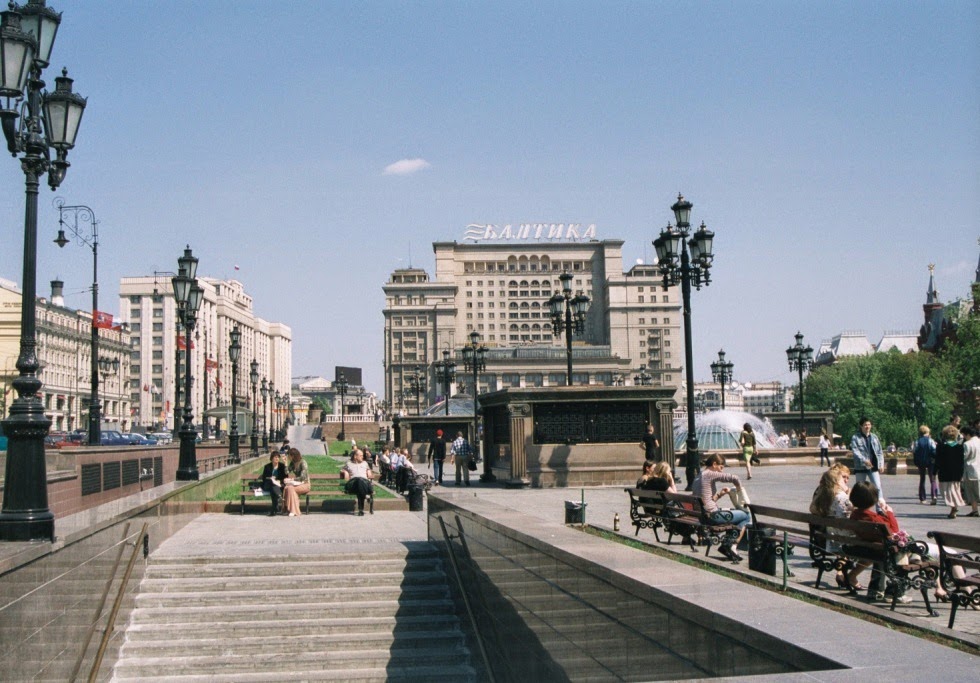 |
| Manezh Square May2002. |
 |
| July 2003 - Before demolition commences. |
 |
| July 2003 - Before demolition commences. |
Taras Schevchenko - Ukrainian poet
 |
| Me and Taras Schevchenko |
Shevchenko dreamed of a Ukraine that would be free of the stifling rule and censorship of the Russian Tsarist Imperial government. Some of Shevchenko's works were also censored by the Soviet Union. Shevchenko was not only a national poet of Ukraine he was also a universal poet. He defended the rights of all peoples to freedom, of human dignity, of women, of Jews, and stressed the importance of education, tradition and heritage. In addition, the renaissance of the Ukrainian language since 1991 is a tribute to Shevchenko's role as the founder of the modern literary Ukrainian language.
Here is his statue which stands in front of the Ukraine Hotel in Moscow.
Subscribe to:
Posts (Atom)