Friday, 22 January 2016

Mark Galeotti: Park Pobedy (Victory Park) – a warrior state’s love poem to itself

https://inmoscowsshadows.wordpress.com/2016/01/19/park-pobedy-victory-park-a-warrior-states-love-poem-to-itself/#comment-1954


"Victory Park, billed as a memorial to the people who fell defending the Motherland but, frankly, rather a monument to tsarist and Soviet regimes that comfortably allowed their people to be used as human ammunition, in the name of defending, asserting or extending its own power."

I visited this park in 2002 and was impressed with the scale of it.

I always find these places slightly unsettling - very moving, but at the back of your mind you question whether the real motive of such grandiose monuments is (or was in Soviet times) to distract the population from their current travails - a reminder of past glories and the huge detrimental effect of the Great Patriotic War on the economy (implying that current living standards remain affected).

And of course, you cannot help but contemplate the appalling loss of life as a consequence of regimes which "allowed their people to be used as human ammunition".  Nevertheless, Victory Park is very impressive and is a beautiful public open space in the spring and summer, especially when the rows of fountains are operational.


In the late eighties, I remember a programme about perestroika, which included (or was presented by) Vladimir Pozner, and included a feature on this monument.  At the time, it was a half-built, already decaying, concrete monstrosity on an abandoned construction site.

If I recall correctly, Brezhnev had commissioned the construction, but there were not sufficient funds to complete it.  Muscovites were beginning to resent the huge sums spent on grandiose monuments during the eighties (and I understand the Gagarin statue on Leninsky Prospekt, completed in 1980, was not well received) and the advent of glasnost allowed this resentment to be expressed more vocally.  I often wondered whether the monument would ever be completed.


10 common Russian superstitions

10 common Russian superstitions: Russians are a very superstitious people. According to a recent Russian Public Opinion Research Center’s (VTsIOM) survey in October 2015, 50 percent of Russians conform their behavior to thei…

Thursday, 21 January 2016

Russia without whom?

Russia without whom?: As the Soviet Union collapsed, a generation had just been born. The online journal Russia without us catalogues their struggle to find a place in today’s Russia. Interview. (opendemocracy.net…

Saturday, 16 January 2016

Cosmonaut's Exhibition - Science Museum


At precisely the time I walked into the Cosmonauts exhibition hall on Friday 15 January 2016, the small steps for me coincided with Tim Peake's giant leap into the cosmos - as Britain's first 'official' astronaut conducted his first space walk, or Extra Vehicular Activity (EVA), from the International Space Station.  A month earlier, Tim Peake launched from Baikonur Cosmodrome on a Russian Sozuz rocket bound for to the International Space Station (ISS), on 15 December 2015, the coverage of which  was beamed live by the BBC from from the Science Museum in London.  This coincided with a major exhibition staged by the Science Museum celebrating Russia's achievements in space.

The Cosmonauts Exhibition opened in September 2015, having been announced at a press conference in May which was attended by Alexei Leonov not long after the 50th anniversary of the anniversary of his space walk - the very first such EVA in March 1965, and Valentina Tereshkova - the first woman in space.


I grew up with the excitement of the space race, especially the lunar landings, space shuttle launches as well as Skylab and the Sozuz-Apollo mission.  Like most kids I knew, I was obsessed with space flight and wanted to be an astronaut when I grew up.  I had an old cine projector on which I would frequently watch a silent, black and white film of the first lunar expedition.  While us in the West were brought up on NASA's achievements in space during the 1970s, and we talk of Astronauts rather than Cosmonauts, I did have a collection of Brooke Bond tea cards which charted mankind's achievements in space - both American and Russian and was often puzzled at the odd lettering, eg CCCP, on the equipment.

Of course at the time, I had no idea as to the political realities influencing or motivating the superpowers during the space race.  I think I had the naive presumption that space was not primarily a military endeavour, but rather a joint exploration arising from mankind's curiosity.  This view was in part reinforced by the Soyuz-Apollo mission whereby Soviet and American modules docked in orbit (such cooperation occurred at the height of the Cold War).  Alexei Leonov, incidentally, was a member of the Russian crew for that mission.


Although the childhood obsession with space exploration waned over the years, some interest remains; the memories of the excitement of those times remain; long forgotten facts endure - locked deep in memory only to resurface when prompted by some external stimulation such as a well curated exhibition like the one at the Science Museum.


Now, I have probably seen many of the exhibits before in Moscow - at the Space Pavilion in Moscow's exhibition park VDNKh or the Cosmonaut Museum housed in the plinth of the titanium Space Explorer's monument near the VDNKh metro station.  However, this was well over 25 years ago, and the last time I was in the Space Pavilion, in 1993, it had been turned into a second-hand car lot selling US cars - such a disappointment, typical of the plunder of the country and cultural insensitivity by the US in the wild 90s.

Anyway, this was so long ago and I can barely recall the artefacts I have seen exhibitions.  The exhibits in Moscow  were so numerous - row upon row of satellites which had the appearance of the innards of a gas boiler bolted onto diving equipment and looking no more sophisticated - that it was hard to absorb any meaningful information.

This is the beauty of the Science Museum's exhibition.  It is a well curated exhibition, with carefully selected artefacts, presented in an imaginative, attractive, and informative way - it manages to capture the excitement of the early years of the space race and the impact it had on the rest of the world.  Of course, the enthusiasm and the knowledge of the volunteer guides adds to the overall experience.  For me, Cosmonauts did evoke memories, unearth long-forgotten facts, re-acquaint me with the familiar, as well as providing much which was new: Helen Sharman's spacesuit from the 1991 Project Juno mission to the Mir space station (Helen Sharman was the first UK-born person in space whereas Tim Peake is the seventh), Valentina Tereshkova's return module (Tereshkova was the first woman in space), lunar lander, lunar rover, space food, and memorabilia relating to Gagarin's 1961 flight and the world's reaction to it.

From the Science museum blog, one of the volunteers sums it up perfectly: "For me there is paradox at the heart of this exhibition. You look at the hardware and you can’t help wondering at how primitive it all looks, as if it was simply bashed together in a workshop. However, you look closer and you begin to see just how awesome and sophisticated it really is. I am captivated by the personalities and the stories, and when you match the stories with the hardware, you begin to understand what true pioneers these people were."

Exit through the gift shop


Last but not least, there was the gift shop.  I was almost as excited by this as I was the exhibition itself - there was a fantastic array of products for sale: posters, books, t-shirts, badges, hats, fridge magnets, even a replica Sozuz 39 cosmonaut flight suit jacket.


I could have spent a fortune.  I passed on the jacket and the Laika shawl, although I did get a t-shirt and a few other nick nacks.


Thursday, 14 January 2016

Korolev died 50 years ago today

Sergei Pavolvich Korolyev - the "Chief Designer" was the head of the Soviet space program in the 1950's and 60's during the early years of the space race.


http://blog.sciencemuseum.org.uk/the-father-of-the-space-age/

Wednesday, 6 January 2016

Happy New Year! С новым годом!


Happy New Year from Dave's Russia Page!

Here is how New Year was greeted in the Golden Ring City of Vladimir - some spectacular views of the city!

Thursday, 24 December 2015

Moscow Metro Instagram Map

The Moscow Times has put together a map that shows each station as documented by commuters on Instagram:

Tuesday, 22 December 2015

What awaits Russia’s economy in 2016 – collapse or recovery? – Johnson's Russia List

What awaits Russia’s economy in 2016 – collapse or recovery? – Johnson's Russia List


Analysts have reacted to the latest collapse of oil prices with varying forecasts. Some believe oil prices are on their way down to the critical level of $35, which would keep the Russian economy in recession. Others, however, including Western analysts, are of the opinion that 2016 may see the first shoots of recovery.

(Russia Beyond the Headlines – rbth.ru – ANNA KUCHMA, RBTH – December 18, 2015)
I recall reading one of those pithy notes of wisdom you get on a desk calendar which said something along the lines of: Remember when you dreamed of earning the salary that you can't live on today
Back in the early 2000's, when oil prices had been languishing around the $10 per barrel mark, they suddenly began their upwards trajectory which would continue for more than a decade.  In 2003, they had reached the $30 per barrel mark, which was considered by analysts at the time to be a massive windfall for the Russian economy.

Wednesday, 18 November 2015

Former General Lord Richards talking sense again


More refreshing stuff from Lord Richards, the former chief of defence staff, on BBC Radio 4 Today programme this morning.

I fear Lord Richards will soon be outed as a Russian internet troll, or one of the so-called "useful idiots" who are manipulated to spread Kremlin lies and propaganda, rather than a respected member of the UK establishment and an ex-military man.

He is proof that you do not have to be a Kremlin stooge, an avid RT viewer or a Putin apologist to express viewpoints which run counter to the anti-Russian sentiment so prevalent in western media.  

I’m sure Lord Richards would insist we maintain our vigilance in monitoring and countering the threat from a well-armed nuclear power who is not considered one of our allies; let’s hope his measured analysis is reflective of the assessments, by our military and intelligence services, of the actual threats facing the UK.

It’s not the first time he has come up with viewpoints favourable to Russia.  Here is what he said in the Times last year about Crimea:

Tuesday, 13 October 2015

The Russia House - Another location "bagged"


As the Russian saying goes "It's better to see once than hear about a hundred times" - Лучше один раз увидеть, чем сто раз услышать (http://blog.therussiahouse.net/2013/07/its-better-to-see-once-than-hear.html), so with that in mind, I set off to bag another location used in the film The Russia House.

In the opening scene of the film, Michelle Pfeiffer's character, Katya Orlova, is seen walking across Red Square then onwards to the Hotel National opposite where she is attending an audio book fare. The scene showing the exterior of the hotel then its foyer and staircase were filmed on location in Moscow - at the Hotel National; but the book fair scene was actually filmed in St Ermin's hotel in London.


Last week, I was on a course in London and was staying in a hotel nearby in Victoria, and I thought: what an execellent opportunity to visit that hotel and see if I can get into that room.  So, I checked in to my hotel, unpacked my bags, then headed off to find St Ermin's hotel, which was a short walk away and close to St James's tube station.

When I got to the hotel, I wasn't sure where exactly the room would be, but on the hotel's website, it appears to be a dining room. With that in mind, I headed for the hotel's dining room / bar / restaurant in the wing to the right of the entrance.  It was clear that I was in the wrong location, so I headed back to the foyer.  I then spotted a corridoor, leading to some bedrooms, but along which I noticed that there were some large doors leading to a darkened room, so I decided to investigate.

This was it.  Smaller than it appeared in the film, and set up for a business presentation, nevertheless I was in the room where the book fair scene took place.  In the semi-darkness, I stood between the columns where the Abercrombie & Blair stand would have been, shut my eyes, caressed the columns and just breathed in the scene- bringing it to life in my imagination, and immersed myself in the scene.

-do you know Mr Bartholomew Scott Blair?
- Barley, sure I know Barley.  The old house of Abercrombie & Blair, publishers - drink or sober, a gent, one of the best.

http://therussiahousescenes.blogspot.co.uk/2013/03/hotel-national-audio-fair.html


Friday, 2 October 2015

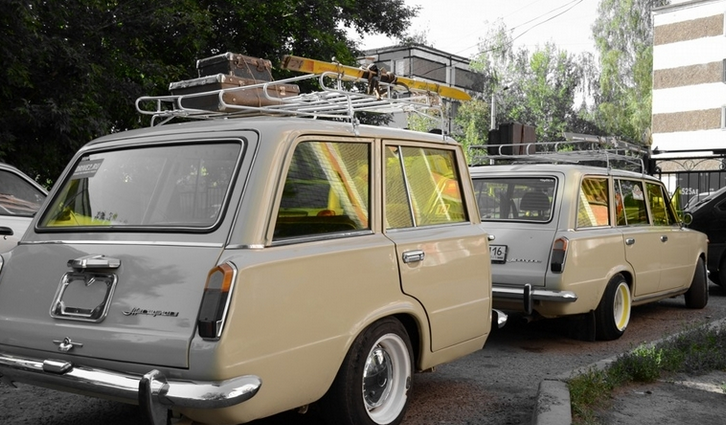
I LOVE Ladas, Me!

From my collection of Soviet Postcards: a set produced by the Togliatti Car Plant.


Bridge from Russia to Crimea now complete


Russia is building a 19 kilometre long bridge from mainland Russia to the Crimean Peninsula which will bypass Ukraine altogether - peninsula’s only land border is with Ukraine - and will connect Kerch in the Crimea to the mainland.

Workers are building temporary bridges that will carry construction machinery and deliver materials to the Kerch bridge site - complete with its own concrete plant and a temporary village of worker's accommodation. Eventually there will be three bridges, but the "technical" bridge has now been completed and is in operation.

A suspension bridge is expected to open to the public in December 2018.

Monday, 28 September 2015

Putin's Speech to the UN: Transcript of Key Points


We all know that after the end of the Cold War the world was left with one center of dominance, and those who found themselves at the top of the pyramid were tempted to think that, since they are so powerful and exceptional, they know best what needs to be done and thus they don’t need to reckon with the UN, which, instead of rubber-stamping the decisions they need, often stands in their way.

We should all remember the lessons of the past. For example, we remember examples from our Soviet past, when the Soviet Union exported social experiments, pushing for changes in other countries for ideological reasons, and this often led to tragic consequences and caused degradation instead of progress.

It seems, however, that instead of learning from other people’s mistakes, some prefer to repeat them and continue to export revolutions, only now these are “democratic” revolutions. Just look at the situation in the Middle East and Northern Africa already mentioned by the previous speaker. Of course, political and social problems have been piling up for a long time in this region, and people there wanted change. But what was the actual outcome? Instead of bringing about reforms, aggressive intervention rashly destroyed government institutions and the local way of life. Instead of democracy and progress, there is now violence, poverty, social disasters and total disregard for human rights, including even the right to life.

I’m urged to ask those who created this situation: do you at least realize now what you’ve done? But I’m afraid that this question will remain unanswered, because they have never abandoned their policy, which is based on arrogance, exceptionalism and impunity.

Power vacuum in some countries in the Middle East and Northern Africa obviously resulted in the emergence of areas of anarchy, which were quickly filled with extremists and terrorists. The so-called Islamic State has tens of thousands of militants fighting for it, including former Iraqi soldiers who were left on the street after the 2003 invasion. Many recruits come from Libya whose statehood was destroyed as a result of a gross violation of UN Security Council Resolution 1973. And now radical groups are joined by members of the so-called “moderate” Syrian opposition backed by the West. They get weapons and training, and then they defect and join the so-called Islamic State.

In fact, the Islamic State itself did not come out of nowhere. It was initially developed as a weapon against undesirable secular regimes. Having established control over parts of Syria and Iraq, Islamic State now aggressively expands into other regions. It seeks dominance in the Muslim world and beyond. Their plans go further.

The situation is extremely dangerous. In these circumstances, it is hypocritical and irresponsible to make declarations about the threat of terrorism and at the same time turn a blind eye to the channels used to finance and support terrorists, including revenues from drug trafficking, the illegal oil trade and the arms trade.

It is equally irresponsible to manipulate extremist groups and use them to achieve your political goals, hoping that later you’ll find a way to get rid of them or somehow eliminate them.

We consider that any attempts to flirt with terrorists, let alone arm them, are short-sighted and extremely dangerous. This may make the global terrorist threat much worse, spreading it to new regions around the globe, especially since there are fighters from many different countries, including European ones, gaining combat experience with Islamic State. Unfortunately, Russia is no exception.